Within the psychological section of my philosophical symbolic system, according to my Ego tripartition scheme, the Ego is subdivided into three parts : Negative Part, Positive Part and Master Part. The Negative Part is represented by those negative principles and ideologies coming from the world surrounding the Ego (such as the justification of violence and the materialistic opportunism). Interestingly, the Positive Part of the Ego originates from the Negative Part of the Ego. In particular, when the opposition to the negative principles of the Negative Part performed by the innate human spirit becomes constant and consistent, the Positive Part comes into existence. More precisely, the Positive Part is made up of a thinking Part, consisting of those positive principles resulting from the opposition to the negative ideologies of the Negative Part and an agent Part, a remote zone of the Ego applying these principles to everyday life contexts. The last component of the Ego is the Master Part, which originates from the Agent Positive Ego and emerges as an extremely positive inner force saving the Positive Part from unbearably negative situations.
The following picture specifies the symbolic groups standing for the three parts of the Ego, according to my philosophical system:

The features of the three key components of the Ego may be appreciated through the description of this second picture:
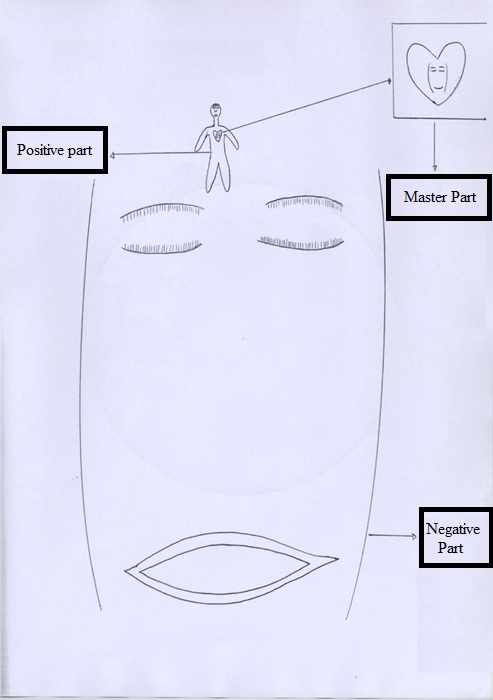
Starting from the negative part, the open mouth shows that the negative part is made up of “mental uttering”, that is to say all those negative ideologies and principles which are stored in our brain. As you can see, here the eyes are shut, meaning that the negative part is not agent. The expression “mental uttering” corresponds to the quantity of information collected in our mind, regardless of how many times data are repeated or reformulated in a different way preserving the same meaning. In light of this, the negative mental uttering is considered on a quantitative basis and, as such, its importance is directly proportional to its quantity;
as for the positive part, it is noticeable that also here the mouth of the human figure is open, meaning that there is some kind of “mental uttering” or philosophical position representing the positive thinking part of the Ego. In addition, contrary to what happens with the negative part, the eyes are here open and inform us that there is an “agent part” within the positive Ego. Differently from the negative part, the positive mental uttering is considered on a qualitative basis, as its significance depends on the consistency, rigour and quality of its principles that are obtained through a synthesis and deconstruction of the negative ideological material; what is more, the agent part is also highlighted by a graphic detail, i.e. the entire human body;
concerning the master part, both mouth and eyes are shut, meaning that this part is neither “thinking” (no mental uttering is expressed), nor “agent” (no practical action is undertaken by this part). As this part originates from the positive agent Ego, its site is in the human heart. Making a contrastive comparison between the shut eyes of the negative Ego and those of the master part, we can notice that in the former the eyes seem to convey terror and fright, whereas in the latter they express calmness and serenity.
For further information, read pages 58-76 of the philosophical treatise
 Philosophical Symbolic System by Lorenzo Rizzelli