In my symbolic system, every symbol (except one that is neutral) does have an ethical meaning, directly or indirectly related to the reject of violence. In English (or another language), if we consider the sentence “Non-violence is my religion”, the single letters included in this sentence taken separately do not express any ethical meaning. If I say in English “I persevere in my hobbies”, you can’t see any reject of violence nor opposing positive spiritual effort in this sentence. If I translate the same sentence in my symbolic language, the reject of violence and opposing spiritual effort are present within the personal pronoun “I”, the verb “persevere plus in” and the noun “hobbies” :

This is the back translation of this symbolic sentence :
Hobbies – to persevere in – Agent Ego (“I”)
Within the symbolic group “hobbies” we can notice : the simple circle (expressing anxiety, persecutions and absolutization of results) and the point (standing for the spiritual opposing force); within the sixth verbal acceptation of the temporal fusion (signalled by the hexagon) we can notice the circle and the point in virtual position (expressing respectively “adult despotic tyranny” and “effort of temporal preservation of positive infant qualities in adulthood”). Within the symbolic group of the Agent Ego, there are important oppositions to consider : the broken slash plus X is the symbolic group expressing the opposition exerted by human reason to negative ideologies coming from family and society (especially materialism and justification of violence); the two double arrows placed in operative position stand for two different kinds of opposition between “good” and “evil” : the first one expresses a process of stabilization following the deconstruction of negative ideologies performed by the human reason (made up of up arrow standing for “ascensional spiritual movement” and down arrow standing for “gravitational downward materialistic force”) whereas the second one expresses the process whereby the positive universal principles (resulting from the stabilization process) are applied to the phenomenic reality (here the up arrow stands for “time” and the down arrow for “space”); in both double arrows, the single up and down arrows are respectively positive and negative symbols. Incidentally, “time” plus “space” in the second double arrow forms the concept of “phenomenon /phenomenic reality” and so, as a process, this double arrow is translated as “phenomenization”.
The mistake that many people make when dealing with my symbolic language is comparing my language with natural languages. They do have different purposes because they arise from different needs: natural languages exist because people need to interact in everyday life contexts; my symbolic language exists only and exclusively because I feel the need to express the reject of violence and to emphasise the role of the human spirit in the fight against evil. The expression “reject of evil ” may also be replaced by “non violent intellectual protest against evil”. Remarkably, this need to express the reject of violence is evidently more powerful than any piece of language expressed in a historical natural language for the reasons I explained : 1) we do not find single letters expressing an ethical meaning recalling the concept of non-violence; 2) the message of non violence is not included in every word and in every sentence. But these two points apply to my symbolic language. I want to point out that there is no competition between natural languages and my symbolic language. They have completely different purposes because they do arise from completely different needs.
In addition, it must be said that my philosophical symbolic language does not have a phonological system. As a result, it can only be written and never be spoken. Each piece of writing can be commented, but any comment is not intended as a feedback to that piece of writing but as a thought that must be considered separately. The fact that this symbolic language is never used in everyday life communication can be realised in the absence of interrogative forms along with the exclusive presence of the third singular and plural persons paired with impersonal expressions. Incidentally, the personal pronoun “I” is symbolically expressed as “the agent part of the Ego”. In light of this, following the literal symbolic translation, “I” is a third person subject. Due to the emphasis on the categorical reject of violence, the personal pronoun “I” is very often used with the verbal tense “Plenitudo temporis aeterni”, so as to highlight the hypercategorical refusal of violence that goes beyond the earthly world because it challenges the neverending time before and after life :
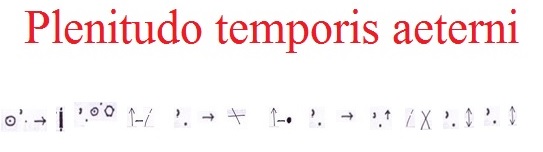
Back translation : hobbies – conceptual full stop – to persevere in – neverending past – and – neverending future – to be in (temporal meaning) – Agent Ego
 Philosophical Symbolic System by Lorenzo Rizzelli