The concepts of “nothing” and “everything”

Within my philosophical symbolic system, the concept of “nothing” is interpreted according to different shades of meaning. This post is focused on two different key acceptations of “nothing” that hold a fundamental importance. Furthermore, a specific acceptation of “everything” will be examined.

The first concept of nothing to be analysed is expressed by the following symbolic group :

By combining two symbols that are diametrically opposite, such as the symbol of the justification of evil (broken slash plus hyphen and down arrow) and that of the fusion between the present and the past (circle with central point topped with virtual basis element) into the symbolic group shown above, we obtain the concept of nothing contextualized in our everyday life experience. In few words, the former means “despotic behaviour, arrogance and opportunism”, whereas the latter stands for the maintenance of one’s infantile positive qualities in adulthood.

Given that the denial of infantile positive qualities takes place when one shows a moral conduct characterized by the features of the symbol of the justification of evil, it follows that the two symbols forming the group shown above are opposite in meaning. The conceptual opposition between the two symbols may be grasped more straightforwardly if you recall the main themes highlighted by poet William Wordsworth in his ode “Intimations of immortality”.

As an idea we normally make use of during our daily routine, the nothing may be seen as the lack of something we do or feel and, as such, is something set in a very concrete and comprehensible context : I ate nothing, I want nothing, etc. For this reason, this nothing is to be interpreted as opposite of something rather than everything. At this level, the nothing keeps its strictly phenomenic meaning.

The second acceptation of “nothing” is the one defining the “nothingness” as something existing instead of the universe. If you recall Gottfried Leibniz’s question “Why is there something rather than nothing?”, you will be able to fully understand this second acceptation of “nothing”. In the context of the symbolic system, this particular notion of nothing is expressed by the emphasis of the “ordinary” nothing considered at the beginning of this post :
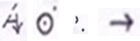
You must keep in mind that the right arrow is the symbolic device expressing the function of “emphasis”, whereas the apostrophe – point symbol is an instrumental device called “operative function”, thanks to which the right arrow acquires the position of “operative symbol”. For this reason, the arrow emphasizes the ordinary concept of nothing, rooted in the phenomenic world and analyzed as first example of this post. In light of this, through this new compound, we emphasize the concept of nothing, obtaining a striking idea within the metaphysical field, that is to say “the nothing as something existing instead of the universe, including its never – ending history”. We may refer to this surprising concept by marking the “Nothing” with the initial capital letter.

The opposite of this second acceptation of nothing is the prominent idea of “Non – nothing”, i.e. the concept of “universe as something existing instead of the Nothing”. From the human perspective, such a universe must be intended in terms of outcome of a divine choice. In symbolic terms, the conventional negativity \ is applied to the “Nothing”, in order to make its opposite :
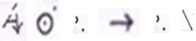
This complex group embodies the fascinating idea of “epiphanic universe”. To begin with, this brilliant expression aims to link the concept of God to the existence of the universe, within the sphere of faith. It must be pointed out that God creates the universe outside of space and time. In view of this, the universe was not created at a specified point in time and will never cease to exist. More precisely, the “epiphany of the universe” implies that the cosmos exists instead of the nothing, because of a divine choice.

Moreover, according to the “epiphanic” perspective, creation is an event that represents a festivity or the edge of happiness. To put it more simply, human beings are to celebrate the festivity of the manifestation of the universe, by thanking God for creating the human race, Planet Earth and the entire universe, reinforcing their faith, giving up violence and aiming at the learning of the world. Interestingly, the concept of the manifestation of the cosmos reflects the etymological meaning of the word “epiphany”. In fact, the latter derives from the Greek word “epiphaneia” that means “manifestation, striking appearance”.

A thorough and succinct explanation of the theological  aspects of my philosophical thought will be provided soon on the website.
The striking example of Artax’s sinking into the swamp of sadness

The striking scene of Artax’s sinking into the swamp of sadness, taken from the movie “The neverending story”, exemplifies one of the most important aspects forming the basis of the philosophical symbolic system, i.e. the gravitational attraction exerted on us by evil.

Artax died in the swamp of sadness due to deeper and deeper depression into which he had fallen. In fact Atreyu, who did not experience feelings such as depression and sadness, was not affected by the force of the swamp. Atreyu knew exactly that the swamp sucks you down if you stop believing you can walk in the swamp. And that’s what happened to Artax, who stopped believing in himself and, as a result, sadness overtook him.

There is a key symbol of the system (the monad symbol) shedding light on this fundamental point :

The monad symbol is a symbolic fusion made up of two components, i.e. the circle and the point. Although the graphic representation of the circle symbol is strictly linked to the notions of negative repetitiveness, persecution and constantly suffered offenses, our attention is instead focused on the concepts of anxiety, depression and lack of self – control (which are also expressed by the circle). Since human beings are limited creatures, every time they feel sadness and discomfort, there is a negative force pushing them progressively to deeper and deeper depression. This is a force (that one can label as “mechanistic”) which is implicit in our human nature, as resulting from purely physical processes. To put it more simply, as a volcano eruption may be considered mechanistic, so in case human beings are victimized, they may tend to react to a given offense,  by molesting physically or verbally another individual, due to a mechanistic force pushing them to commit an evil act. The concept of gravitational attraction exerted by evil on us represents a creative way of explaining the mechanistic negative force. Additionally, persistent anxiety and depression might lead to self – harming behaviour and, in the most extreme cases, to suicide.

Having said all this, what I want to bring to the fore is the fact that human beings are not made up solely of flesh and blood and cannot be considered like a “volcano”. Indeed, we are made up also of spirit and reason, which enable us to successfully keep our negative instincts under control, preventing us from committing offenses against others or ourselves. Let us move now on to introducing the second part of this explanation, related to the point symbol, which is inside the circle. The latter refers to a spiritual force or strong willpower exerting its action inside us, contrasting any gravitational evil attraction. Indeed, the spiritual positivity expressed by the point exerts an upward action whereby we are relieved from the gravitational evil attraction.

By recalling the fascinating example of Artax’s sinking into the swamp of sadness, we may assert that the force exerted by the swamp, which is clearly fuelled by the depression affecting the horse, may be associated with the gravitational downward force exerted by depression, anxiety and lack of self – control on us, which are three key ideas of the circle forming the monad symbol. On the other hand, Atreyu’s attempt to pull desperately on Artax’s bridle may, to some degree, approximate the ascensional movement of the spirit through which human beings break free from depression and anxiety. In my view, Atreyu’s attempt is unsuccessful because only the strength of will coming from the self can rescue ourselves from depression. In detail, this aspect is particularly crucial in the symbol of the monad, since the ascensional movement of the spirit must necessarily be an autonomous action, not depending on external elements. With regard to the two opposite movements mentioned, i.e. the gravitational and the ascensional ones, they are symbolized respectively by the down and up arrows, also included within the philosophical symbolic system.

Brief overview of the verbal tenses in Symbolic Grammar II

In this short video, I will provide you with a very brief picture about verbal tenses in Symbolic Grammar II. In the next updates, I will explain the verbal structure underpinning the various verbal tenses :

Here follows the back translation of each symbolic sentence. In order to have a general idea about the verbal structures, you can stop the video and look through the following explanation. All the elements are literally translated, reading the symbolic sentences from left to right.

First sentence (Simple present):

Crimes – to commit (applicative function) – human beings

Second sentence (Present perfect) :

Genitorial body – to generate (applicative function) – someone (those) – conceptual full stop – to shadow (applicative function) – childhood (temporal specification) – to be in (spatial meaning) – human beings

Third sentence (Historic Present Perfect) :

Crimes – Conceptual full stop – to commit (applicative function) – Planet Earth (spatial specification) – to be in (temporal meaning) – human beings

Fourth sentence (Simple past) :

Crimes – conceptual full stop – to commit (applicative function) – the past (temporal specification) – to be in (temporal meaning) – human beings

Decomposition of the element “the past” : symbol of moral negativity + hyphen + symbol of time

Fifth sentence (Simple future) :

Crimes – conceptual full stop – to commit (applicative function) – the future (temporal specification) – to be in (temporal meaning) – human beings

Decomposition of the element “the future” : symbol of mental projection + hyphen + symbol of time

Sixth sentence (Infinite past and future) :

Infinite past – Discontinuous conjunction “and” – Infinite future (both elements joined together by the conjunction “and” form the temporal specification) – to be in (temporal meaning) – the universe

Decomposition of the element “Infinite past” : symbol of universal moral negativity + hyphen + symbol of time + operative function + symbol of emphatic function (the Infinite past is interpreted as an emphatic form of the simple past)

Decomposition of the element “Infinite future” : symbol of mental projection + hyphen + symbol of time + operative function + symbol of emphatic function (the Infinite future is interpreted as an emphatic form of the simple future)

Seventh sentence (Plenitudo temporis aeterni) :

Hobbies (Grammar One compound) – conceptual full stop – to persevere in (applicative function) – Infinite past – Discontinuous conjunction “and” – Infinite future (both elements joined together by the conjunction “and” form the temporal specification) – to be in (temporal meaning) – I

Decomposition of the Grammar One compound “hobbies” : symbol of ethical monad – operative function – symbol of emphatic function

The decompositions of the infinite past and future have already been illustrated.

Decomposition of the subject pronoun “I” (Grammar One compound standing for the agent part of the Ego) :

Symbol of universal moral negativity – symbol of innate spirit (and also human reason) – operative function – operative function of ethical stabilization (first double arrow) – operative function – operative function of “putting into practice in a concrete everyday life context” (second double arrow)

The Plenitudo temporis aeterni refers to “intentionality” rather than “action”. By stating that “I persevere in my hobbies in the infinite past and future” I do not logically mean that I have always persevered in my hobbies before my life and I will continue to do so forever after my life”. Instead, the sentence has the following meaning : in my earthly life I hypercategorically conform to an ethical principle according to which “I must always persevere in my hobbies”. The PTA (Plenitudo temporis aeterni) differs from the simple sum of infinite past and future (solely involving the elliptical verb “to be”).

The main features of Symbolic Grammar Two

Grammar II is a revolutionary system of rules characterized by original grammatical categories forming its basis. Here follows a list of the main revolutionary aspects :

1) The category “verb” is called “applicative function” and is made up of two basic components : “applicative” and “applicative medium”; the former indicates that there is a transformation whereas the latter specifies the kind of transformation; the verbal system includes some revolutionary tenses, such as the stunning “plenitudo temporis aeterni”;

2) The category “clause” (including the verb “to be”, the stative verbs but not the characterization function) is called “verbal function”, which generally consists of three components : “the applied element” (object), “the applicative function” (verb) and “the applier” (subject);

3) Subordinates are interpreted as complementary sentences of the main clauses; it is the symbol located at the top right of the characterization symbol to define the kind of subordinate; nonetheless, not all the complementary functions are subordinates;

4) The full stop does not exist. Each symbolic sentence is introduced by a beginning marker and closed by an end marker;

5) The grammatical system includes a series of divisor devices : the characterization function (plus its emphasis) and the conceptual full stop (plus its two emphasises); the conceptual full stop is a key device in the formation of relative clauses;

6) Modal verbs are seen as verbal modifiers along with the negation “not” and other symbolic devices;

7) There is a level going beyond the verbal one, i.e. the so – called “macro – verbal”. The “macro – verbality” is a highly important grammatical innovation;

8) Adverbs are etymologically interpreted as additional verbal information and this is clearly supported from the graphic point of view;

9) Adjectives are represented in different ways, from the graphic point of view, according to whether they are “predicate” or “descriptive”; possessive adjectives may either appear explicitly (through an intermediate function) or be elliptical (marked in bold within the treatise);

10) There are different kinds of verb “to be” : “to be in (temporal)”; “to be in (spatial)”; “to be (universal)”; “to be (particular)”; “to be (opinion level)”; “to be (divine)”; “to mean”;

11) Comparatives and superlatives are formed thanks to nominalized forms of the predicate adjective;

12) There are various devices used to avoid repetition of information.