Success and achievement: The light of dynamicity

The present blog update is focused on one of the most practical aspects of the Philosophical Symbolic System because the connection with everyday life is very evident. Is it possible that a philosophical system centered on non-violence has got a very powerful and clear idea of what achievement and success are? The answer is yes.

Within the philosophical symbolic system there are two key acceptations of results expressed by their corresponding symbolic representations. The most basic one (from the symbolic point of view) is the negative acceptation of result expressed by the symbol of the down arrow:

The meanings attributed to this symbol are the following:

–  Result as something obtained without any sacrifice and building up the materialistic attitude of an individual (examples are gifts or inheritance);

– Result as something that must be obtained at any cost, even through violence or unjust methods;

– Result as something that, if not obtained, leads to deep depression and ultimately to suicide;

– Result as a threshold artificially and relatively set by humans that paradoxically acquires an absolute standard (in the last three cases we describe results as “absolutized”);

– Result as something representing a stationary point that does not need any progression;

– Result cumulatively conceived as an amount of results achieved because of contingency/luck of staying alive.

– Result as something achieved after overcoming one’s performance (eg. I managed to do better than my friend and so that is a great result).

Although all these negative meanings of the down arrow must not necessarily be present altogether to form the key idea of negative result, some of these meanings are more crucial than others. In particular, the most important meanings are the first four meanings listed above. As a matter of fact, the concepts of materialism, gravitational force of evil/negative emotions and result as absolutized are retrieved directly from the list of the meanings of the down arrow.

More subtly, the absence of dynamicity relates indirectly to the concept of space that is the first meaning of the down arrow. As for contingency and luck of staying alive, the first of these two ideas connects to the ephemeral contingent nature of our world expressed more precisely by the double arrow symbol (sum of down and up arrow). Interestingly, luck of staying alive derives instead from the symbolic fusion of the justification of evil for positive causes, made up by the universal symbol of negativity and the down arrow. This fusion stands also for adult tyranny and adult dimension, characterized by the loss of innocence and cruel opportunism. Luck of staying alive is intrinsic in this negative acceptation of the adult dimension that is evinced by the down arrow fused with moral negativity. This is the illustrated fusion:

As for the last shade of meaning listed above, comparing oneself with others is inconsistent and inaccurate as people have different life experiences. On this basis, the only rigorous comparison is with ourselves, as it will be shown later in this blog update. From the symbolic point of view, this negative shade does not emerge directly from the down arrow but from a symbol that is linked directly to the latter, i.e. the circle. As a matter of fact, darkness, lack of emotional harmony and especially obsession are basic meanings of the circle that relate with the concept of result as something great achieved after outperforming someone.

Let us now describe the positive acceptation of result that is expressed by the negation of the fusion between present and past. This time the acceptation is one but the explanation is split into four parts:

– When we think of results in a positive light we refer to them as the outcomes of a process characterized by perseverance and sacrifice. In this context, it is not the result to be absolutized but the strength of will. Since we are not sure to live enough to achieve a result, the latter can never be an absolute whereas we are sure about the fact that the determination and willingness to achieve a result are at the highest level, provided that we manifest spirituality, also in spite of negative circumstances.

– This acceptation of result never is compatible with violence as the symbol of the fusion between the present and the past mitigated by conventional negativity is still a very positive concept. Also the same fusion never is compatible with depression and anxiety because of its inner symbolic structure (circle + internal point + point in upper position) that also represents the idea of temporal and spiritual preservation.

– In addition, result is conceived as something intrinsically dynamic because it is the outcome of a process. While negating the fusion between the present and the past through the symbol of conventional negativity, we notice that this negation corresponds to a situation in which past and present are separated (because negated by the backlash symbol) while still being part of a path. In the context of this path, the past represents the “becoming history of the result” (or progression towards the result) and the present stands for the outcome achieved thanks to the sacrifice and perseverance characterizing the past.

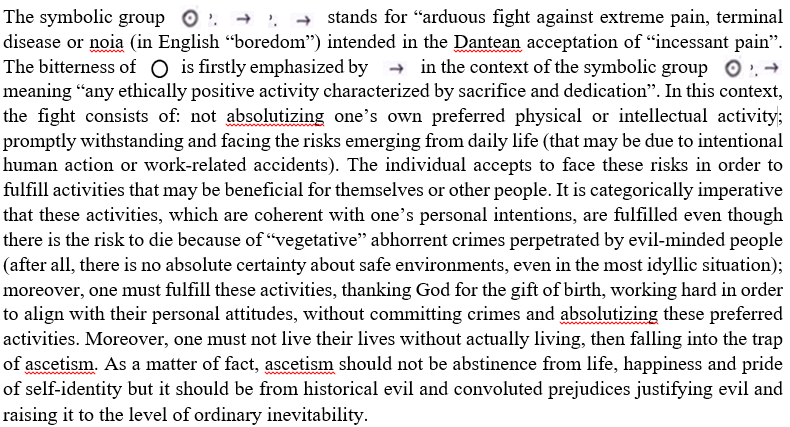
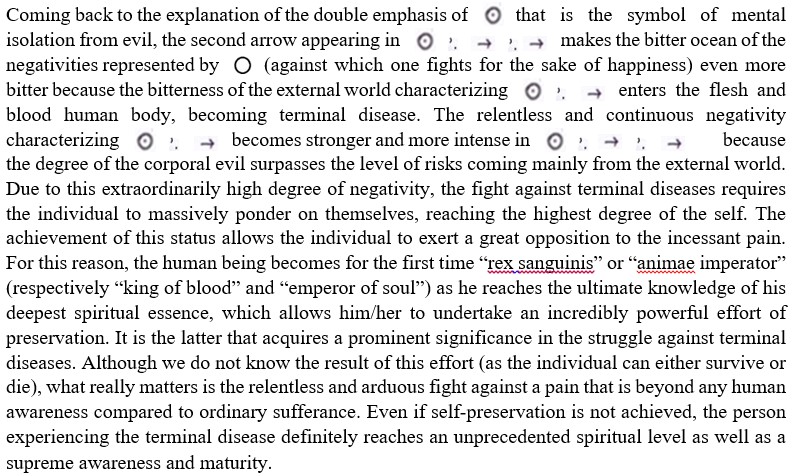
– As anticipated above, another positive acceptation of result is positive outcome reached after comparing our performances in different periods of time, in order to realize any improvements. This comparison holds a great degree of accuracy as each of us has got a thorough knowledge of their life experiences and data are very precise, especially under similar living conditions. In symbolic terms, the ideas of dynamicity and positive self-pride are clearly evident in the circle + internal point. Very subtly, the reader that wants to deepen more the concept of positive self-pride would benefit from the explanation of the activities characterized by sacrifice and perseverance outlined here:

How can this be put in terms of guideline offered by the philosophical symbolic system?

Thinking of non violence as breathing the air

By reinforcing a topic already illustrated in the blog feed, I do clarify that the main difference between my constructed language and natural languages resides in the fact that the latter tend to consider the reject of violence as a contingent part of the communication. As a matter of fact, most of the words we use in our everyday life do not involve reject of violence nor control of negative emotions. What is more, we tend to focus on the opposition to violence when negative events such as rapes, murders and suicides take place and then we come back to our everyday life routine mode that is not focused on the reject of violence. By contrast, in my constructed symbolic language, the reject of violence is immanent and not contingent because it is overwhelmingly predominant in the various words (or concepts) employed in the symbolic written form.

Just to provide an example, in Italian/English or other languages, if I say “the child perseveres in his/her hobbies”, the concept of non violence is absent. By contrast, in my symbolic language, the concept of non violence is within the symbolic chain translating the words “child”, “persevere” and “hobbies”. These are just three words but I might mention also other words embodying non violence in my symbolic language. If non violence is immanent in the symbolic expression, this means that it is within the individual all the time. If in a hypothetical language most words involve the concept of non violence, this means that this concept is expressed by us from the moment in which we get up in the morning until the moment we go to bed in the night. Just to provide an incredibly and astonishingly effective example, thinking of non violence in this kind of language is like our “breathing the air”, “blood flowing in our body” or “our heartbeat”. I mentioned these examples because, as you can notice, these are events that accompany us in our life every single second. So the philosophical symbolic system and its related language assume that thinking of non violence should be exactly the same as breathing the air, the blood flowing or the heartbeat. Can you imagine what would happen in a kind of society in which non violence is internalized in this way? I do not think that people can speak a language whose structure is based on non violence and then they end up killing or raping someone.

Of course, my constructed language is not designed for human interaction and communication. So its features would be different from those of the mentioned hypothetical language. In spite of this, the fact that the lexicon and symbolic sentences of my language are based upon non violence make this idea as an ever-present pillar of the written symbolic expression. The example of a hypothetical language based mainly on non violence is not what I have done but a suggestion for the future. I have mentioned it to clarify the concept of immanence (or ever-presence) of non violence in my symbolic language. The reason why my constructed language is not designed for human interaction resides in the fact that the function of the symbolic system is to emphasize (through symbols) an idea that is previously expressed in the natural language. In light of this, the symbolic language cannot replace a language but it is something that we add to it and the element that we add is the powerful emphasis. For example, if I say “I persevere in my hobbies” in any natural language, the translation of this sentence into my symbolic language brings the same meaning expressed by the natural language but emphasized in an astonishing way (we could say emphasized as it is any number except 0 when is to the power of infinity (eg. 2∞) .

Overview of the philosophical symbolic system by Lorenzo Rizzelli

Following the recommendation provided by a Linkedin contact, I have decided to start a series of videos on my philosophical symbolic system. Here follows what you find in this video:
Very brief overview of the definition, purpose and function of the philosophical symbolic system;
Thematic pathway (theme of never-ending time) to develop further the purpose of persuasion;
Evolution of the philosophical symbolic system into a philosophical constructed language;
Comparison between the latter and natural languages, in terms of approach towards the concept of violence.

Philosophical symbolic system – Quizzes

Quiz (Philosophical section)

1) What is the fundamental aim of the philosophical symbolic system designed by L. Rizzelli :

– To show how a philosophical thought can be organised through symbols

– To show how symbols can represent philosophical ideas

– To persuade people to reject violence

– To persuade people to come up with independent and original thoughts

2) Which answer best defines the symbolic group standing for the emphasis of the circle including a point at its centre:

– Hobbies

– Any demanding positive activity characterised by perseverance and sacrifice

– Intellectual activities

– Meditation

– Jobs

3) What is the specific function of the symbolic writing:

– To facilitate the understanding of complex philosophical concepts

– To compete with natural languages through symbolic representations

– To emphasize a message that would have been poor if solely expressed through plain language

– To demonstrate that the symbolic constructed language is the best expression of human creativity

4) Which statement about results, according to the philosophical system, is true :

– They must be obtained at any cost

– Their importance is drastically undermined by the strength of will

– They are associated with spiritualism

– Violence is permitted, as long as it is needed for their actual fulfilment

5) Which form of evil characterises the negative seed (or base) in the double emphasis of the circle including a point at its centre?

– Slight verbal offense

– Natural calamity

– Murder

– Terminal disease

6) According to the key concept of Vollkommenheit (German word expressing one key symbolic group), what induces human beings to give up suicide :

– Concept of life as earthly paradise

– Concept of life as temporal prison

– Concept of life as one-off chance

– Concept of life as infernal fire

7) What is the purpose of the Master part in the psychological tripartition of the Ego :

– to defeat and deconstruct negative ideologies

– to call into question the stability of positive ethical principles

– to save the positive Agent Ego from unbearably negative situations

– to replace the positive Agent Ego

8) Which sequence of concepts is totally associated with “slight offenses”:

– parental body, instincts, human limitedness

– instincts, human limitedness, anxiety

– anxiety, parental body, persecution

– human limitedness, parental body, reason

9) Which factor contributes to the importance of the Negative Part of the Ego:

– Quantity of information

– Quantity and quality of information

– Strong impact of information

– Quality of information

10) Choose the right order of these actions performed by the human reason, culminating in the genesis of the Thinking Part of the Ego:

– Deconstructing negative ideologies, Negating negative ideologies, Pondering on negative ideologies, Stabilization of unchangeable positive principles

– Pondering on negative ideologies, Deconstructing negative ideologies, Negating negative ideologies, Stabilization of unchangeable positive principles

– Pondering on negative ideologies, Deconstructing negative ideologies, Stabilization of unchangeable positive principles, Negating negative ideologies

– Pondering on negative ideologies, Negating negative Ideologies, Deconstructing negative ideologies, Stabilization of unchangeable positive principles

11) What is the best strategy when dealing with human feelings and emotions, according to the concept of emotional fusion?

– Trying to avoid negative thoughts

– Constantly taking an optimistic approach to life

– Mentally reproducing negative emotions while feeling happy and viceversa

– Meditation

12) What is the temporal dimension characterising the symbol of universal ethical negativity :

– Past

– Present

– Future

– Any temporal dimension

13) Which phobia approximates, to some degree, the concept of “ribk” :

– Autophobia

– Apeirophobia

– Claustrophobia

– Acrophobia

14) Which sequence of words illustrates concepts expressed by all the three symbols of human spirit :

– Reason, innate entity, inner force

– Self – consciousness, reason, temporal preservation

– Innate entity, self – consciousness, inner force

– Inner force, reason, logical capability

15) Which opposition best describes the difference between the two fundamental concepts of “human body” :

– Perfection vs imperfection

– Human flesh vs any material

– Instincts vs reason

– Egoism vs altruism

16) How is it possible to mathematically represent the Epiphanic Universe (two answers) (according to the system and not in accordance with mathematical laws):

– Inverse of exponentiation of zero

– Inverse of Infinity

– Exponentiation of inverse of zero

– Exponentiation of infinity

17) Which is the idea shared by all the oppositions of “zero concepts” :

– Sufficiency

– Totality

– Clarity

– Simplicity

18) Which expression describes how our lexical choices are affected by single events belonging to our near past :

– Temporal fusion

– Retrospective speech

– Lexical alignment

– Conversational coincidence

19) Which symbolic definition refers to the figure of speech of “irony”:

– Opposite of anxiety

– Opposite of ethical stability

– Opposite of ethical positivity

– Opposite of ethical negativity

20) Which symbolic definition also includes the figure of speech of “hyperbole”:

– Exponentiation of thought

– Exponentiation of force

– Exponentiation of human spirit

– Exponentiation of dream

21) Which philosophical concept approximates the emphasis of the “ribk”:

– Determinism

– Egoism

– Solipsism

– Egocentrism

Quiz (Grammatical Section)

1) Which grammatical category is closer to the concept of “verb” :

Applicative

– Applier

– Applicative function

– Verbal function

2) How can you render the concepts of “applier” and “applied element” according to English Grammar, in the most precise way?

– Subject and object

– Object and subject

– Complement and subject

– Agent and patient

3) What is the purpose of the applicative?

– To specify the content of an action

– To signal a kind of transformation/change of state

– To specify a kind of applier

– To indicate a kind of tense

4) Among the following statements, which one(s) is/are true?

– In the past, future, never-ending past, never-ending future and plenitudo temporis aeterni forms of the same verb, the applicative function never changes

– In the past, future, never-ending past, never-ending future and plenitudo temporis aeterni forms of the same verb, the applicative medium changes

– In the past, future, never-ending past, never-ending future and plenitudo temporis aeterni forms of the same verb, the applier changes

– In the past, future, never-ending past, never-ending future and plenitudo temporis aeterni forms of the same verb, the temporal specification changes

– In the past, future, never-ending past, never-ending future and plenitudo temporis aeterni forms of the same verb, sometimes the applier is a nominal whole

5) Among the following symbolic divisors, which one can be used as verb “to be”?

– Conceptual full stop

– Function of characterization

– Super Conceptual full stop

– Hyper Conceptual full stop

6) In which of the following structures there is a defining relative clause?

– Verbal function (clause) preceded or followed by conceptual full stop

– Verbal function (clause) preceded or followed by function of characterization

– Verbal function (clause) preceded by beginning sentence marker

– Applier plus specification

7) In which of the following structures there is a defining relative clause?

– Flying Vebax

– Verbal function (clause) preceded or followed by function of characterization

– Fulksen Function

– Bluhette Function

8) Which is the distinctive feature of macro verbality?

– An applicative function at the end of the symbolic sentence

– An applicative function at the beginning of the symbolic sentence

– The absence of an applicative function

– An applicative function beyond the end of the symbolic sentence

9)   What is the effect that the implicit function of characterization produces on the specified element?

– It turns it into its plural form

– The specified element is then preceded by “some”

– The specified element is then preceded by “all”

– It attenuates its meaning

10) What is the feature of conceptual factorization?

– The decomposed elements are universal and justified by logical reasoning

– The decomposed elements are arbitrary and unjustified

– The decomposed elements are phenomenical

– The decomposed elements are arbitrary but justified by empirical evidence or logical reasoning

11) Which grammatical categories are rendered into English within a Groen Function:

– Complement of time and temporal adverb

– Genitive form, complement of specification, noun plus adjective

– Adjective, adverb and genitive form

– Complement of time, adjective and adverb

12) Which are the full features of the Plenitudo temporis aeterni:

– The applier is always the personal pronoun “I” and the verb expresses absolute intentionality

– The applier may be any rational being and the applicative medium is absent

– The applier is always the personal pronoun “I” and the verb may also refer to actions

– The sum of the never ending past and future plus absence of applicative medium

– The absence of the applicative and the presence of absolute intentionality

13) Which key structure is present in clauses introduced by “when/while”, “before” and “after”:

– Temporal implicit function of characterization

– Adverbial mixed structure

– Adverbial Groen Function

– Temporal explicit function of characterization

– Adverbial simple structure

14) Which is the only personal pronoun expressed through a Grammar One symbolic compound:

– “You”

–  “I”

– “They”

– “We

Philosophical symbolic language vs Natural languages

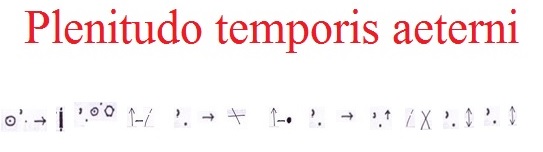
In my symbolic system, every symbol (except one that is neutral) does have an ethical meaning, directly or indirectly related to the reject of violence. In English (or another language), if we consider the sentence “Non-violence is my religion”, the single letters included in this sentence taken separately do not express any ethical meaning. If I say in English “I persevere in my hobbies”, you can’t see any reject of violence nor opposing positive spiritual effort in this sentence. If I translate the same sentence in my symbolic language, the reject of violence and opposing spiritual effort are present within the personal pronoun “I”, the verb “persevere plus in” and the noun “hobbies” :

This is the back translation of this symbolic sentence :

Hobbies – to persevere in – Agent Ego (“I”)

Within the symbolic group “hobbies” we can notice : the simple circle (expressing anxiety, persecutions and absolutization of results) and the point (standing for the spiritual opposing force); within the sixth verbal acceptation of the temporal fusion (signalled by the hexagon) we can notice the circle and the point in virtual position (expressing respectively “adult despotic tyranny” and “effort of temporal preservation of positive infant qualities in adulthood”). Within the symbolic group of the Agent Ego, there are important oppositions to consider : the broken slash plus X is the symbolic group expressing the opposition exerted by human reason to negative ideologies coming from family and society (especially materialism and justification of violence); the two double arrows placed in operative position stand for two different kinds of opposition between “good” and “evil” : the first one expresses a process of stabilization following the deconstruction of negative ideologies performed by the human reason (made up of up arrow standing for “ascensional spiritual movement” and down arrow standing for “gravitational downward materialistic force”) whereas the second one expresses the process whereby the positive universal principles (resulting from the stabilization process) are applied to the phenomenic reality (here the up arrow stands for “time” and the down arrow for “space”); in both double arrows, the single up and down arrows are respectively positive and negative symbols. Incidentally, “time” plus “space” in the second double arrow forms the concept of “phenomenon /phenomenic reality” and so, as a process, this double arrow is translated as “phenomenization”.

The mistake that many people make when dealing with my symbolic language is comparing my language with natural languages. They do have different purposes because they arise from different needs: natural languages exist because people need to interact in everyday life contexts; my symbolic language exists only and exclusively because I feel the need to express the reject of violence and to emphasise the role of the human spirit in the fight against evil. The expression “reject of evil ” may also be replaced by “non violent intellectual protest against evil”. Remarkably, this need to express the reject of violence is evidently more powerful than any piece of language expressed in a historical natural language for the reasons I explained : 1) we do not find single letters expressing an ethical meaning recalling the concept of non-violence; 2) the message of non violence is not included in every word and in every sentence. But these two points apply to my symbolic language. I want to point out that there is no competition between natural languages and my symbolic language. They have completely different purposes because they do arise from completely different needs.

In addition, it must be said that my philosophical symbolic language does not have a phonological system. As a result, it can only be written and never be spoken. Each piece of writing can be commented, but any comment is not intended as a feedback to that piece of writing but as a thought that must be considered separately. The fact that this symbolic language is never used in everyday life communication can be realised in the absence of interrogative forms along with the exclusive presence of the third singular and plural persons paired with impersonal expressions. Incidentally, the personal pronoun “I” is symbolically expressed as “the agent part of the Ego”. In light of this, following the literal symbolic translation, “I” is a third person subject. Due to the emphasis on the categorical reject of violence, the personal pronoun “I” is very often used with the verbal tense “Plenitudo temporis aeterni”, so as to highlight the hypercategorical refusal of violence that goes beyond the earthly world because it challenges the neverending time before and after life :

Back translation : hobbies – conceptual full stop – to persevere in – neverending past – and – neverending future – to be in (temporal meaning) – Agent Ego

The psychology of the Ego: the tripartition scheme

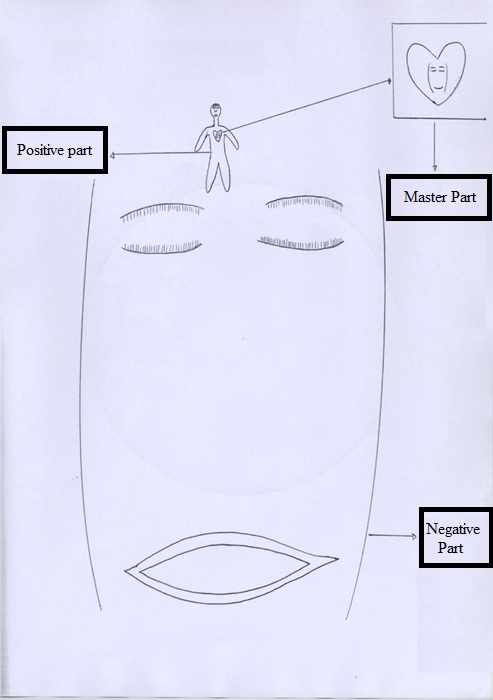
Within the psychological section of my philosophical symbolic system, according to my Ego tripartition scheme, the Ego is subdivided into three parts : Negative Part, Positive Part and Master Part. The Negative Part is represented by those negative principles and ideologies coming from the world surrounding the Ego (such as the justification of violence and the materialistic opportunism). Interestingly, the Positive Part of the Ego originates from the Negative Part of the Ego. In particular, when the opposition to the negative principles of the Negative Part performed by the innate human spirit becomes constant and consistent, the Positive Part comes into existence. More precisely, the Positive Part is made up of a thinking Part, consisting of those positive principles resulting from the opposition to the negative ideologies of the Negative Part and an agent Part, a remote zone of the Ego applying these principles to everyday life contexts. The last component of the Ego is the Master Part, which originates from the Agent Positive Ego and emerges as an extremely positive inner force saving the Positive Part from unbearably negative situations.

The following picture specifies the symbolic groups standing for the three parts of the Ego, according to my philosophical system:

The features of the three key components of the Ego may be appreciated through the description of this second picture:

Starting from the negative part, the open mouth shows that the negative part is made up of “mental uttering”, that is to say all those negative ideologies and principles which are stored in our brain. As you can see, here the eyes are shut, meaning that the negative part is not agent. The expression “mental uttering” corresponds to the quantity of information collected in our mind, regardless of how many times data are repeated or reformulated in a different way preserving the same meaning. In light of this, the negative mental uttering is considered on a quantitative basis and, as such, its importance is directly proportional to its quantity;

as for the positive part, it is noticeable that also here the mouth of the human figure is open, meaning that there is some kind of “mental uttering” or philosophical position representing the positive thinking part of the Ego. In addition, contrary to what happens with the negative part, the eyes are here open and inform us that there is an “agent part” within the positive Ego. Differently from the negative part, the positive mental uttering is considered on a qualitative basis, as its significance depends on the consistency, rigour and quality of its principles that are obtained through a synthesis and deconstruction of the negative ideological material; what is more, the agent part is also highlighted by a graphic detail, i.e. the entire human body;

concerning the master part, both mouth and eyes are shut, meaning that this part is neither “thinking” (no mental uttering is expressed), nor “agent” (no practical action is undertaken by this part). As this part originates from the positive agent Ego, its site is in the human heart. Making a contrastive comparison between the shut eyes of the negative Ego and those of the master part, we can notice that in the former the eyes seem to convey terror and fright, whereas in the latter they express calmness and serenity.

For further information, read pages 58-76 of the philosophical treatise

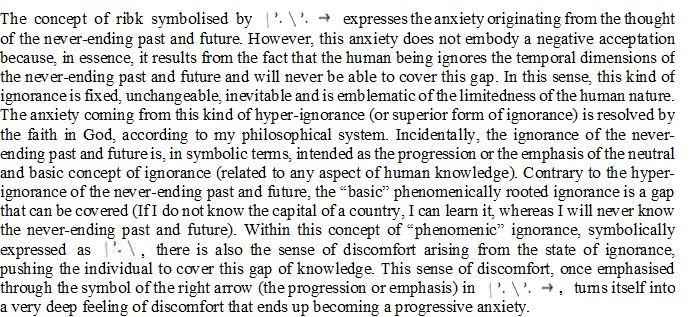
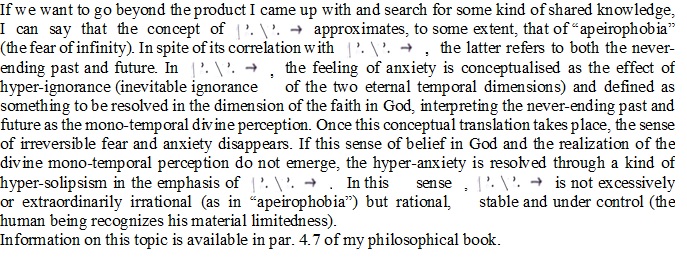
Ribk and Apeirophobia

The association between the concept of “ribk” (translated through symbols in the eplanation here provided) and that of “apeirophobia” (the fear of infinity) is fascinating. Nonetheless, the former pertains to the emotional and gnoseological levels, whereas the latter pertains to the emotional and psychological levels. Here follows the explanation :

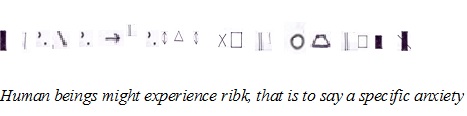
Here follows a symbolic sentence including the symbolic group expressing the notion of “ribk” :

Back translation :

Beginning of symbolic sentence – ribk – symbolic of atomic conceptual factorization – to experience (passive meaning, if read from left to right and active meaning if read from right to left) – may/might – human beings – complementary function (expressing additional information) of meaning – anxiety (seventh meaning of the circle signalled by the isosceles trapezoid – a specific (on page 297 of my philosophical group, the symbolic sequence expressing “a specific” is fully clarified) – end of symbolic sentence

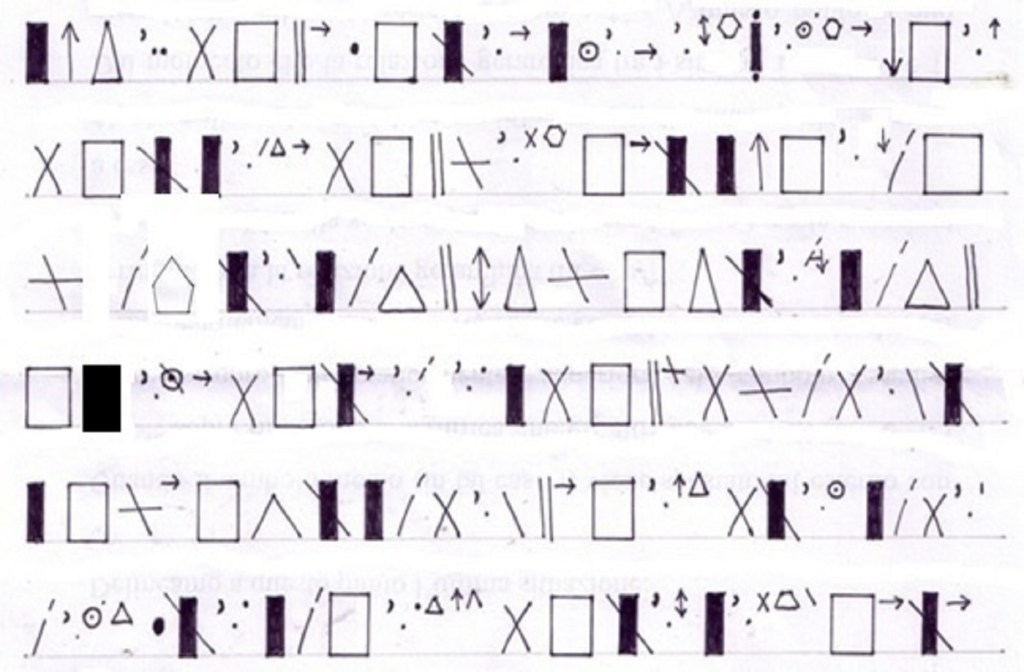
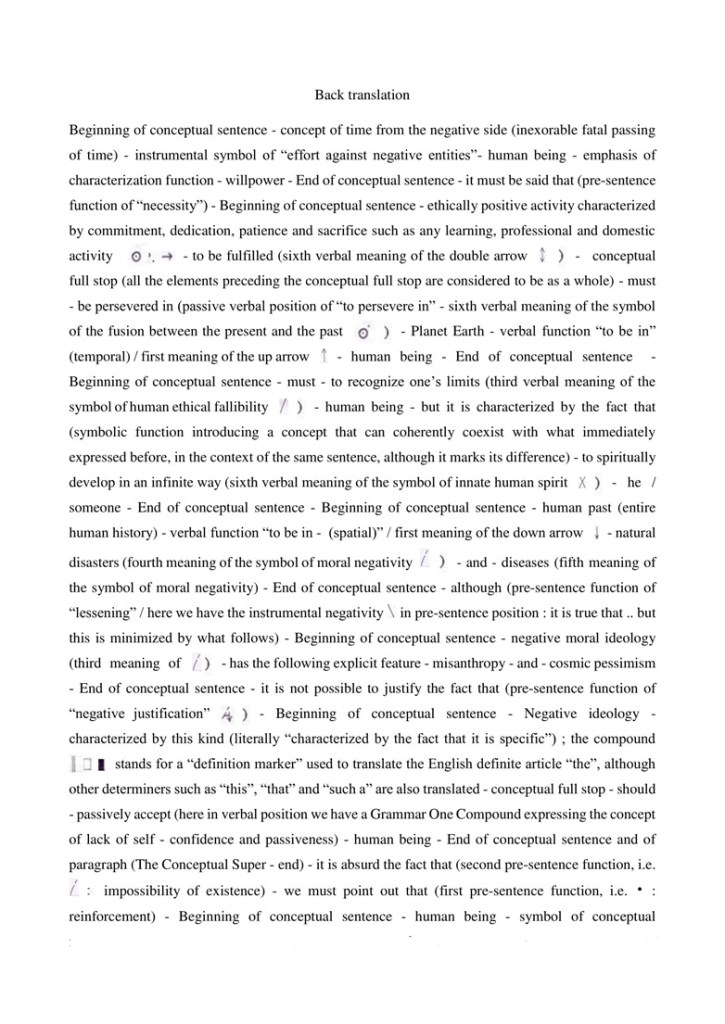
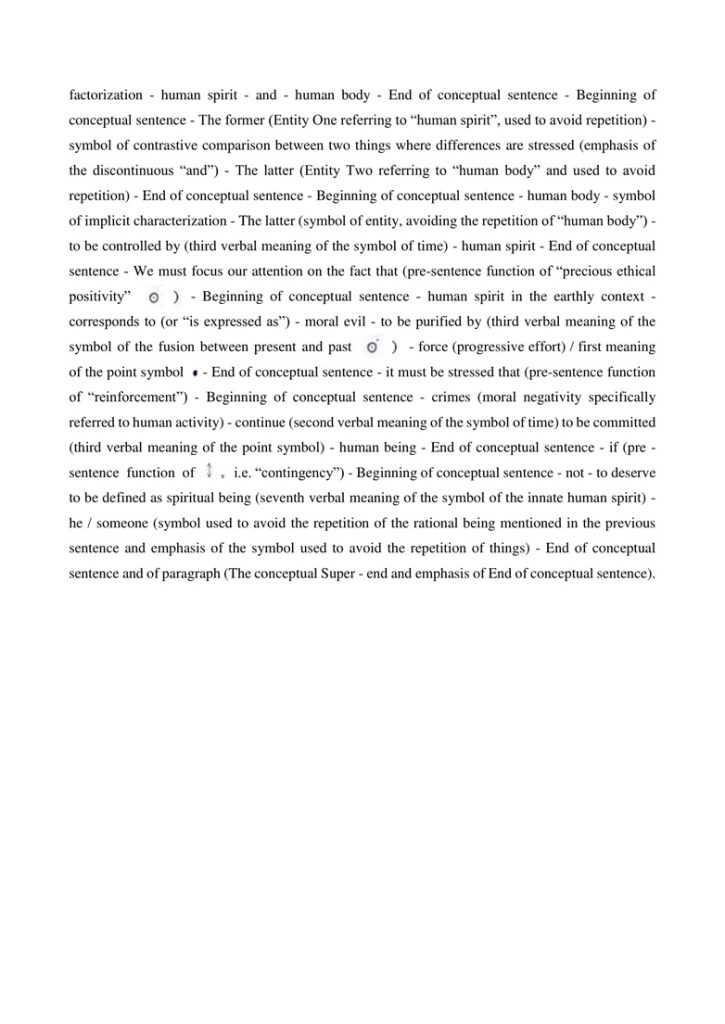
Example of Grammar Two Symbolic Writing

Ordinary translation

It must be said that the human being, facing the inexorable (fatal) passing of time, is characterized by a willpower that is implicit in him. The human being has always had to persevere, since his appearance on Planet Earth, in his learning, professional and domestic activities, that are fulfilled. He must recognize his limits but he is aimed at continuous self-improvement, developing in an infinite manner. Although there have been natural disasters and diseases throughout human history, an ideology characterized by misanthropy and cosmic pessimism cannot be justified. We must point out that it is absurd that the human being should passively accept such a negative ideology. The human being consists of spirit and material body. These are compared so that divergences emerge. In particular, we must concentrate on the fact that the human body is essentially something which is controlled by spirit. It must be stressed that the human spirit in the earthly context corresponds to a force purifying evil. If the human being continues to commit crimes, he does not deserve to be defined as spiritual.

Complements and subordinates in Philosophical Symbolic Grammar Two

The introduction of grammatical complements and subordinates represents a crucial and important step forward towards the set – up of my philosophical constructed language. Interestingly, the structure of symbolic complements and subordinates is the same : in both cases, the pieces of information expressed are interpreted as specific additional information of the main clause; if the additional information is a nominal element (noun or nominal group), this corresponds to a complement; by contrast, if the supplementary information is a clause, then we deal with a subordinate.

For the purpose of this analysis, let us firstly take into consideration two examples of simple (key) additional information, before introducing examples of symbolic complements and subordinates :

The fact that a specific philosopher investigates evil is characterized by originality

The fact that a specific philosopher investigates evil is characterized by the fact that he (pro – form referring back to “philosopher”) is (opinion level) original

In both cases, the main clause preceding the additional function of characterization (double straigh line) is called “entry information”, whereas what follows this function is called “specification”. As you can see, in the first example, the additional piece of information is represented by the nominal element “originality” whereas in the second one, the specification is rendered as a clause (“he is original”).

Incidentally, the expression “the fact that” does not appear explicitly in terms of symbols but it emerges in the English rendering of two symbolic chains (namely, entry information and specification). In view of this, let us explore the literal structure of the symbolic chains in both examples :

Beginning mark of sentenceevil – to investigate – philosopher – a specific – characterization function – originalityEnd mark of sentence

Beginning mark of sentence – evil – to investigate – philosopher – a specific – characterization function – he (pro – form) – to be (opinion level) – original – End mark of sentence

All said this, complements and subordinates are seen as specific (not key) additional information. In all cases, the additional function of characterization (double straight line) is topped with a specific symbol of the system, so that it specifies the kind of supplementary information.

Here follow some basic examples of complements and subordinates expressing concession, cause, purpose, time and space. It must be kept in mind that only a few complementary functions introduce ordinary complements or subordinates :

  1. Concession :

The hobbies that the child fulfils are interesting despite their demandingness

Back translation :

Beginning mark of sentence – hobbies – to fulfil – child – conceptual full stop – to be (contingent sense) – Kien function – interesting (predicate adjective form) – complementary function of concession introducing a nominal element (complement of concession) – them – of – demandingness (Groen function) – End mark of sentence

The hobbies that the child fulfils are interesting despite the fact that they are undermined by the surrounding environment

(The hobbies that the child fulfils are interesting but they are undermined by the surrounding environment)

Back translation :

Beginning mark of sentence – hobbies – to fulfil – child – conceptual full stop – to be (contingent sense) – Kien function – interesting (predicate adjective form) – complementary function of concession introducing a clause (concessive subordinate) – they (pro – form referring back to “hobbies”) – to undermine – surrounding environment – End mark of sentence

2. Cause :

The child experiences lack of self – esteem (G1 compound) because of anxiety

Beginning mark of sentence – lack of self esteem – to experience – child – complementary function of cause introducing a nominal element (complement of cause) – anxiety – End mark of sentence

A specific hobby is disregarded because it is not interesting

Back translation :

Beginning mark of sentence – hobby – specific – to disregard – complementary function of cause introducing a clause (causative subordinate) – it (pro – form referring back to “hobby”) – not to be (negative form of contingent “to be”) – interesting (predicate adjective form) – End mark of sentence

3. Purpose :

The child perseveres in his passions for the purpose of his spiritual growth

Back translation :

Beginning mark of sentence – hobbies (passions) – to persevere in – child – complementary function of purpose introducing a nominal element (complement of purpose) – spiritual growth – End mark of sentence

The child perseveres in his passions in order to strengthen his commitment

(The child perseveres in his passions so that he strengthens his commitment)

Back translation :  

Beginning mark of sentence – hobbies (passions) – to persevere in – child – complementary function of purpose introducing a clause (purpose clause) – commitment – to strengthen – he (pro – form referring back to “child”) – End mark of sentence

4. Time :

The child experiences anxiety during his childhood     

Back translation :

Beginning mark of sentence – anxiety – to experience – child – complementary function of time introducing a nominal element (complement of time) – him – of – childhood (Groen function) – End mark of sentence

The child experiences lack of self – esteem when the surrounding environment undermines his hobbies

Back translation :

Beginning mark of sentence – lack of self esteem – to experience – child – complementary function of time introducing a clause (temporal clause) – him – of – hobbies (Groen function) – to undermine – surrounding environment – End mark of sentence

5. Place :

Human beings committed saddening crimes on Planet Earth

Back translation :

Beginning mark of sentence – saddening (qualifying adjective form) – crimes (Groen function) – conceptual full stop – to commit – the past – to be in (temporal meaning) – human beings – complementary function of place introducing a nominal element (place complement) – Planet Earth – End mark of sentence

The child improves his activity where the surrounding environment encourages him

Back translation :

Beginning mark of sentence – activity – to improve – child – complementary function of place introducing a clause (place subordinate) – him (pro – form referring back to “child”) – to encourage – surrounding environment – End mark of sentence

Further readings :

Details on the characterization function : pages 174 – 203 of the philosophical book

Complementary functions : pages 203 – 226 of the philosophical book

Explanation of the symbolic group defining the concept of “hobbies” (passions) : page 20 of the philosophical book

Explanation of the symbolic group expressing the concept of “lack of self – esteem” : page 19 of the philosophical book

Beginning mark of sentence” and “End mark of sentence” : pages 128 and 130 of the philosophical book

Conceptual full stop : pages 182 – 203 of the philosophical book

Different kinds of the verb “to be” : pages 167 – 173 of the philosophical book

Kien Function : pages 224 and 343 of the philosophical book

Predicate adjectives and qualifying adjectives : page 223 and pages 320 – 336 of the philosophical book

Groen function : pages 217 – 219 and pages 220 – 225 of the philosophical book

Pro – forms : pages 156 – 160 and pages 310 – 319 of the philosophical book

Explanation of the symbolic group defining the concept of “purpose” (that appears at the top right corner of the characterization function in complementary functions of purpose) : page 23 of the philosophical book

Explanation of the verbal tense “simple past” : pages 153 – 154 of the philosophical book