Quiz (Philosophical section)
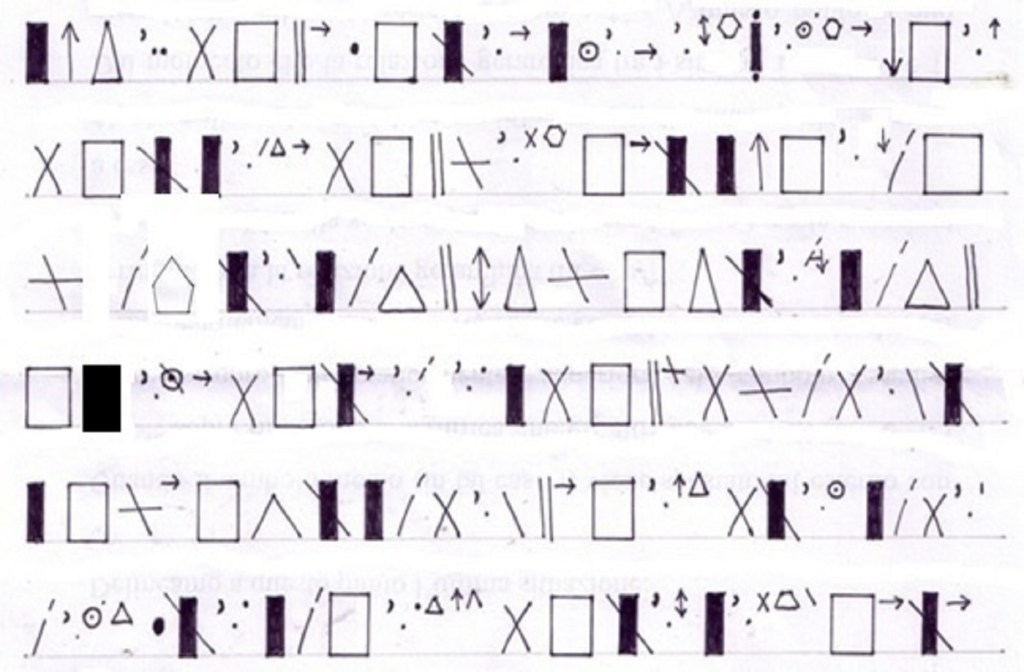
1) What is the fundamental aim of the philosophical symbolic system designed by L. Rizzelli :
– To show how a philosophical thought can be organised through symbols
– To show how symbols can represent philosophical ideas
– To persuade people to reject violence
– To persuade people to come up with independent and original thoughts
2) Which answer best defines the symbolic group standing for the emphasis of the circle including a point at its centre:
– Hobbies
– Any demanding positive activity characterised by perseverance and sacrifice
– Intellectual activities
– Meditation
– Jobs
3) What is the specific function of the symbolic writing:
– To facilitate the understanding of complex philosophical concepts
– To compete with natural languages through symbolic representations
– To emphasize a message that would have been poor if solely expressed through plain language
– To demonstrate that the symbolic constructed language is the best expression of human creativity
4) Which statement about results, according to the philosophical system, is true :
– They must be obtained at any cost
– Their importance is drastically undermined by the strength of will
– They are associated with spiritualism
– Violence is permitted, as long as it is needed for their actual fulfilment
5) Which form of evil characterises the negative seed (or base) in the double emphasis of the circle including a point at its centre?
– Slight verbal offense
– Natural calamity
– Murder
– Terminal disease
6) According to the key concept of Vollkommenheit (German word expressing one key symbolic group), what induces human beings to give up suicide :
– Concept of life as earthly paradise
– Concept of life as temporal prison
– Concept of life as one-off chance
– Concept of life as infernal fire
7) What is the purpose of the Master part in the psychological tripartition of the Ego :
– to defeat and deconstruct negative ideologies
– to call into question the stability of positive ethical principles
– to save the positive Agent Ego from unbearably negative situations
– to replace the positive Agent Ego
8) Which sequence of concepts is totally associated with “slight offenses”:
– parental body, instincts, human limitedness
– instincts, human limitedness, anxiety
– anxiety, parental body, persecution
– human limitedness, parental body, reason
9) Which factor contributes to the importance of the Negative Part of the Ego:
– Quantity of information
– Quantity and quality of information
– Strong impact of information
– Quality of information
10) Choose the right order of these actions performed by the human reason, culminating in the genesis of the Thinking Part of the Ego:
– Deconstructing negative ideologies, Negating negative ideologies, Pondering on negative ideologies, Stabilization of unchangeable positive principles
– Pondering on negative ideologies, Deconstructing negative ideologies, Negating negative ideologies, Stabilization of unchangeable positive principles
– Pondering on negative ideologies, Deconstructing negative ideologies, Stabilization of unchangeable positive principles, Negating negative ideologies
– Pondering on negative ideologies, Negating negative Ideologies, Deconstructing negative ideologies, Stabilization of unchangeable positive principles
11) What is the best strategy when dealing with human feelings and emotions, according to the concept of emotional fusion?
– Trying to avoid negative thoughts
– Constantly taking an optimistic approach to life
– Mentally reproducing negative emotions while feeling happy and viceversa
– Meditation
12) What is the temporal dimension characterising the symbol of universal ethical negativity :
– Past
– Present
– Future
– Any temporal dimension
13) Which phobia approximates, to some degree, the concept of “ribk” :
– Autophobia
– Apeirophobia
– Claustrophobia
– Acrophobia
14) Which sequence of words illustrates concepts expressed by all the three symbols of human spirit :
– Reason, innate entity, inner force
– Self – consciousness, reason, temporal preservation
– Innate entity, self – consciousness, inner force
– Inner force, reason, logical capability
15) Which opposition best describes the difference between the two fundamental concepts of “human body” :
– Perfection vs imperfection
– Human flesh vs any material
– Instincts vs reason
– Egoism vs altruism
16) How is it possible to mathematically represent the Epiphanic Universe (two answers) (according to the system and not in accordance with mathematical laws):
– Inverse of exponentiation of zero
– Inverse of Infinity
– Exponentiation of inverse of zero
– Exponentiation of infinity
17) Which is the idea shared by all the oppositions of “zero concepts” :
– Sufficiency
– Totality
– Clarity
– Simplicity
18) Which expression describes how our lexical choices are affected by single events belonging to our near past :
– Temporal fusion
– Retrospective speech
– Lexical alignment
– Conversational coincidence
19) Which symbolic definition refers to the figure of speech of “irony”:
– Opposite of anxiety
– Opposite of ethical stability
– Opposite of ethical positivity
– Opposite of ethical negativity
20) Which symbolic definition also includes the figure of speech of “hyperbole”:
– Exponentiation of thought
– Exponentiation of force
– Exponentiation of human spirit
– Exponentiation of dream
21) Which philosophical concept approximates the emphasis of the “ribk”:
– Determinism
– Egoism
– Solipsism
– Egocentrism
Quiz (Grammatical Section)
1) Which grammatical category is closer to the concept of “verb” :
– Applicative
– Applier
– Applicative function
– Verbal function
2) How can you render the concepts of “applier” and “applied element” according to English Grammar, in the most precise way?
– Subject and object
– Object and subject
– Complement and subject
– Agent and patient
3) What is the purpose of the applicative?
– To specify the content of an action
– To signal a kind of transformation/change of state
– To specify a kind of applier
– To indicate a kind of tense
4) Among the following statements, which one(s) is/are true?
– In the past, future, never-ending past, never-ending future and plenitudo temporis aeterni forms of the same verb, the applicative function never changes
– In the past, future, never-ending past, never-ending future and plenitudo temporis aeterni forms of the same verb, the applicative medium changes
– In the past, future, never-ending past, never-ending future and plenitudo temporis aeterni forms of the same verb, the applier changes
– In the past, future, never-ending past, never-ending future and plenitudo temporis aeterni forms of the same verb, the temporal specification changes
– In the past, future, never-ending past, never-ending future and plenitudo temporis aeterni forms of the same verb, sometimes the applier is a nominal whole
5) Among the following symbolic divisors, which one can be used as verb “to be”?
– Conceptual full stop
– Function of characterization
– Super Conceptual full stop
– Hyper Conceptual full stop
6) In which of the following structures there is a defining relative clause?
– Verbal function (clause) preceded or followed by conceptual full stop
– Verbal function (clause) preceded or followed by function of characterization
– Verbal function (clause) preceded by beginning sentence marker
– Applier plus specification
7) In which of the following structures there is a defining relative clause?
– Flying Vebax
– Verbal function (clause) preceded or followed by function of characterization
– Fulksen Function
– Bluhette Function
8) Which is the distinctive feature of macro verbality?
– An applicative function at the end of the symbolic sentence
– An applicative function at the beginning of the symbolic sentence
– The absence of an applicative function
– An applicative function beyond the end of the symbolic sentence
9) What is the effect that the implicit function of characterization produces on the specified element?
– It turns it into its plural form
– The specified element is then preceded by “some”
– The specified element is then preceded by “all”
– It attenuates its meaning
10) What is the feature of conceptual factorization?
– The decomposed elements are universal and justified by logical reasoning
– The decomposed elements are arbitrary and unjustified
– The decomposed elements are phenomenical
– The decomposed elements are arbitrary but justified by empirical evidence or logical reasoning
11) Which grammatical categories are rendered into English within a Groen Function:
– Complement of time and temporal adverb
– Genitive form, complement of specification, noun plus adjective
– Adjective, adverb and genitive form
– Complement of time, adjective and adverb
12) Which are the full features of the Plenitudo temporis aeterni:
– The applier is always the personal pronoun “I” and the verb expresses absolute intentionality
– The applier may be any rational being and the applicative medium is absent
– The applier is always the personal pronoun “I” and the verb may also refer to actions
– The sum of the never ending past and future plus absence of applicative medium
– The absence of the applicative and the presence of absolute intentionality
13) Which key structure is present in clauses introduced by “when/while”, “before” and “after”:
– Temporal implicit function of characterization
– Adverbial mixed structure
– Adverbial Groen Function
– Temporal explicit function of characterization
– Adverbial simple structure
14) Which is the only personal pronoun expressed through a Grammar One symbolic compound:
– “You”
– “I”
– “They”
– “We
 Philosophical Symbolic System by Lorenzo Rizzelli