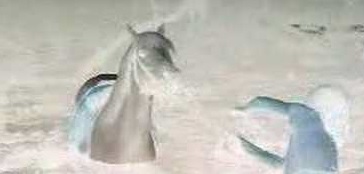
The striking scene of Artax’s sinking into the swamp of sadness, taken from the movie “The neverending story”, exemplifies one of the most important aspects forming the basis of the philosophical symbolic system, i.e. the gravitational attraction exerted on us by evil.
Artax died in the swamp of sadness due to deeper and deeper depression into which he had fallen. In fact Atreyu, who did not experience feelings such as depression and sadness, was not affected by the force of the swamp. Atreyu knew exactly that the swamp sucks you down if you stop believing you can walk in the swamp. And that’s what happened to Artax, who stopped believing in himself and, as a result, sadness overtook him.
There is a key symbol of the system (the monad symbol) shedding light on this fundamental point :

The monad symbol is a symbolic fusion made up of two components, i.e. the circle and the point. Although the graphic representation of the circle symbol is strictly linked to the notions of negative repetitiveness, persecution and constantly suffered offenses, our attention is instead focused on the concepts of anxiety, depression and lack of self – control (which are also expressed by the circle). Since human beings are limited creatures, every time they feel sadness and discomfort, there is a negative force pushing them progressively to deeper and deeper depression. This is a force (that one can label as “mechanistic”) which is implicit in our human nature, as resulting from purely physical processes. To put it more simply, as a volcano eruption may be considered mechanistic, so in case human beings are victimized, they may tend to react to a given offense, by molesting physically or verbally another individual, due to a mechanistic force pushing them to commit an evil act. The concept of gravitational attraction exerted by evil on us represents a creative way of explaining the mechanistic negative force. Additionally, persistent anxiety and depression might lead to self – harming behaviour and, in the most extreme cases, to suicide.
Having said all this, what I want to bring to the fore is the fact that human beings are not made up solely of flesh and blood and cannot be considered like a “volcano”. Indeed, we are made up also of spirit and reason, which enable us to successfully keep our negative instincts under control, preventing us from committing offenses against others or ourselves. Let us move now on to introducing the second part of this explanation, related to the point symbol, which is inside the circle. The latter refers to a spiritual force or strong willpower exerting its action inside us, contrasting any gravitational evil attraction. Indeed, the spiritual positivity expressed by the point exerts an upward action whereby we are relieved from the gravitational evil attraction.
By recalling the fascinating example of Artax’s sinking into the swamp of sadness, we may assert that the force exerted by the swamp, which is clearly fuelled by the depression affecting the horse, may be associated with the gravitational downward force exerted by depression, anxiety and lack of self – control on us, which are three key ideas of the circle forming the monad symbol. On the other hand, Atreyu’s attempt to pull desperately on Artax’s bridle may, to some degree, approximate the ascensional movement of the spirit through which human beings break free from depression and anxiety. In my view, Atreyu’s attempt is unsuccessful because only the strength of will coming from the self can rescue ourselves from depression. In detail, this aspect is particularly crucial in the symbol of the monad, since the ascensional movement of the spirit must necessarily be an autonomous action, not depending on external elements. With regard to the two opposite movements mentioned, i.e. the gravitational and the ascensional ones, they are symbolized respectively by the down and up arrows, also included within the philosophical symbolic system.
 Philosophical Symbolic System by Lorenzo Rizzelli