Within my philosophical symbolic system, the concept of “nothing” is interpreted according to different shades of meaning. This post is focused on two different key acceptations of “nothing” that hold a fundamental importance. Furthermore, a specific acceptation of “everything” will be examined.
The first concept of nothing to be analysed is expressed by the following symbolic group :

By combining two symbols that are diametrically opposite, such as the symbol of the justification of evil (broken slash plus hyphen and down arrow) and that of the fusion between the present and the past (circle with central point topped with virtual basis element) into the symbolic group shown above, we obtain the concept of nothing contextualized in our everyday life experience. In few words, the former means “despotic behaviour, arrogance and opportunism”, whereas the latter stands for the maintenance of one’s infantile positive qualities in adulthood.
Given that the denial of infantile positive qualities takes place when one shows a moral conduct characterized by the features of the symbol of the justification of evil, it follows that the two symbols forming the group shown above are opposite in meaning. The conceptual opposition between the two symbols may be grasped more straightforwardly if you recall the main themes highlighted by poet William Wordsworth in his ode “Intimations of immortality”.
As an idea we normally make use of during our daily routine, the nothing may be seen as the lack of something we do or feel and, as such, is something set in a very concrete and comprehensible context : I ate nothing, I want nothing, etc. For this reason, this nothing is to be interpreted as opposite of something rather than everything. At this level, the nothing keeps its strictly phenomenic meaning.
The second acceptation of “nothing” is the one defining the “nothingness” as something existing instead of the universe. If you recall Gottfried Leibniz’s question “Why is there something rather than nothing?”, you will be able to fully understand this second acceptation of “nothing”. In the context of the symbolic system, this particular notion of nothing is expressed by the emphasis of the “ordinary” nothing considered at the beginning of this post :
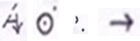
You must keep in mind that the right arrow is the symbolic device expressing the function of “emphasis”, whereas the apostrophe – point symbol is an instrumental device called “operative function”, thanks to which the right arrow acquires the position of “operative symbol”. For this reason, the arrow emphasizes the ordinary concept of nothing, rooted in the phenomenic world and analyzed as first example of this post. In light of this, through this new compound, we emphasize the concept of nothing, obtaining a striking idea within the metaphysical field, that is to say “the nothing as something existing instead of the universe, including its never – ending history”. We may refer to this surprising concept by marking the “Nothing” with the initial capital letter.
The opposite of this second acceptation of nothing is the prominent idea of “Non – nothing”, i.e. the concept of “universe as something existing instead of the Nothing”. From the human perspective, such a universe must be intended in terms of outcome of a divine choice. In symbolic terms, the conventional negativity \ is applied to the “Nothing”, in order to make its opposite :
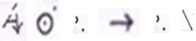
This complex group embodies the fascinating idea of “epiphanic universe”. To begin with, this brilliant expression aims to link the concept of God to the existence of the universe, within the sphere of faith. It must be pointed out that God creates the universe outside of space and time. In view of this, the universe was not created at a specified point in time and will never cease to exist. More precisely, the “epiphany of the universe” implies that the cosmos exists instead of the nothing, because of a divine choice.
Moreover, according to the “epiphanic” perspective, creation is an event that represents a festivity or the edge of happiness. To put it more simply, human beings are to celebrate the festivity of the manifestation of the universe, by thanking God for creating the human race, Planet Earth and the entire universe, reinforcing their faith, giving up violence and aiming at the learning of the world. Interestingly, the concept of the manifestation of the cosmos reflects the etymological meaning of the word “epiphany”. In fact, the latter derives from the Greek word “epiphaneia” that means “manifestation, striking appearance”.
A thorough and succinct explanation of the theological aspects of my philosophical thought will be provided soon on the website.
 Philosophical Symbolic System by Lorenzo Rizzelli