By reinforcing a topic already illustrated in the blog feed, I do clarify that the main difference between my constructed language and natural languages resides in the fact that the latter tend to consider the reject of violence as a contingent part of the communication. As a matter of fact, most of the words we use in our everyday life do not involve reject of violence nor control of negative emotions. What is more, we tend to focus on the opposition to violence when negative events such as rapes, murders and suicides take place and then we come back to our everyday life routine mode that is not focused on the reject of violence. By contrast, in my constructed symbolic language, the reject of violence is immanent and not contingent because it is overwhelmingly predominant in the various words (or concepts) employed in the symbolic written form.
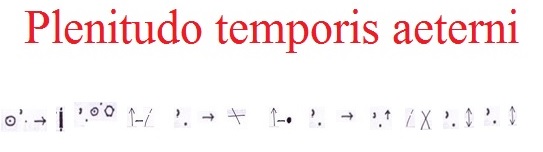
Just to provide an example, in Italian/English or other languages, if I say “the child perseveres in his/her hobbies”, the concept of non violence is absent. By contrast, in my symbolic language, the concept of non violence is within the symbolic chain translating the words “child”, “persevere” and “hobbies”. These are just three words but I might mention also other words embodying non violence in my symbolic language. If non violence is immanent in the symbolic expression, this means that it is within the individual all the time. If in a hypothetical language most words involve the concept of non violence, this means that this concept is expressed by us from the moment in which we get up in the morning until the moment we go to bed in the night. Just to provide an incredibly and astonishingly effective example, thinking of non violence in this kind of language is like our “breathing the air”, “blood flowing in our body” or “our heartbeat”. I mentioned these examples because, as you can notice, these are events that accompany us in our life every single second. So the philosophical symbolic system and its related language assume that thinking of non violence should be exactly the same as breathing the air, the blood flowing or the heartbeat. Can you imagine what would happen in a kind of society in which non violence is internalized in this way? I do not think that people can speak a language whose structure is based on non violence and then they end up killing or raping someone.
Of course, my constructed language is not designed for human interaction and communication. So its features would be different from those of the mentioned hypothetical language. In spite of this, the fact that the lexicon and symbolic sentences of my language are based upon non violence make this idea as an ever-present pillar of the written symbolic expression. The example of a hypothetical language based mainly on non violence is not what I have done but a suggestion for the future. I have mentioned it to clarify the concept of immanence (or ever-presence) of non violence in my symbolic language. The reason why my constructed language is not designed for human interaction resides in the fact that the function of the symbolic system is to emphasize (through symbols) an idea that is previously expressed in the natural language. In light of this, the symbolic language cannot replace a language but it is something that we add to it and the element that we add is the powerful emphasis. For example, if I say “I persevere in my hobbies” in any natural language, the translation of this sentence into my symbolic language brings the same meaning expressed by the natural language but emphasized in an astonishing way (we could say emphasized as it is any number except 0 when is to the power of infinity (eg. 2∞) .

 Philosophical Symbolic System by Lorenzo Rizzelli